
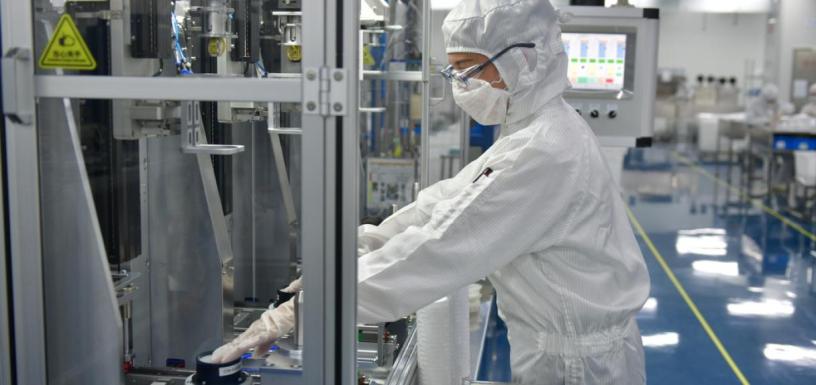
A medical device cleanroom is a purpose-built manufacturing environment where air filtration, pressure differentials, temperature control, and personnel protocols work together to keep airborne particle counts below the limits that a device’s contamination risk profile requires. The cleanroom is not simply a tidy room with a filter. It is a validated system, qualified through commissioning tests, monitored continuously during production, and requalified when significant changes affect the environment’s performance. For manufacturers producing devices that contact sterile tissue, deliver drugs, or are implanted in the body, the cleanroom is as much a part of the manufacturing process as the equipment inside it.
ISO Classification Standards
Cleanroom classification follows ISO 14644-1, which defines allowable particle concentrations at specified sizes for each class level. ISO Class 5 permits a maximum of 3,520 particles of 0.5 microns or larger per cubic metre of air, making it suitable for fill-and-finish operations and sterile device assembly where the highest contamination control is required. ISO Class 7 permits 352,000 particles per cubic metre and suits most medical device assembly operations. ISO Class 8, at 3,520,000 particles per cubic metre, applies to less contamination-sensitive manufacturing stages.
The classification a facility must achieve is determined by the device risk class, the intended use, and the regulatory requirements for the markets where the device will be sold. A manufacturer supplying both FDA-regulated and CE-marked devices must satisfy the more stringent of the two sets of requirements, which in practice means building and operating to the ISO classification the device demands regardless of regional differences in the regulatory framework.
How a Cleanroom Maintains Its Class
A medical device cleanroom maintains its classification through HEPA filtration, controlled air change rates, and positive pressure relative to adjacent spaces. HEPA filters at ceiling level deliver unidirectional or turbulent clean air downward through the room, displacing contaminated air towards low-level return vents. The number of air changes per hour varies by classification, with ISO Class 5 unidirectional flow rooms typically achieving 240 to 360 changes per hour.
Positive pressure relative to corridors and anteroom spaces prevents contaminated air from flowing into the cleanroom when doors open. Personnel enter through a gowning anteroom where they don the required garments before breaching the classified area, preventing the particle load of corridor air from reaching production. The pressure cascade runs from cleanest to least clean, with the highest pressure in the most critical zones.
Temperature and humidity control serve both contamination management and process requirements. Many medical device assembly materials and adhesives have defined working ranges, and cleanroom HVAC systems maintain the conditions that keep materials within their validated parameters throughout the production shift.
Facility Qualification
Before a cleanroom can be used for medical device production, it must be qualified through a series of tests that demonstrate it meets its design specification. Installation qualification confirms that the HVAC system, filtration, and monitoring infrastructure were installed as designed. Operational qualification verifies that the room achieves its target classification under normal operating conditions. Performance qualification demonstrates that the room maintains classification with the full complement of equipment and personnel present during actual production.
“The safety of patients depends on the environments in which their devices are made, not just on the design of the devices themselves,” Minister for Health Ong Ye Kung has noted in addresses to Singapore’s healthcare manufacturing sector. Facility qualification translates that principle into documented evidence that a specific room, on a specific day, meets the standard it claims.
Monitoring During Production
A qualified medical device cleanroom remains qualified only if it is monitored continuously during production. Particle counters at specified locations sample air at defined intervals and log data against acceptance limits. Temperature and humidity sensors record conditions throughout the shift. Pressure differential gauges at room boundaries confirm that the pressure cascade is maintained.
Surface particle monitoring through settle plates or contact plates supplements airborne particle data for environments where surface contamination poses a direct product risk. Deviations from monitoring limits trigger defined responses: investigation of the cause, assessment of the impact on products manufactured during the excursion, and corrective action to prevent recurrence. The monitoring records form part of the batch history for every product made in the room and must be retained for the period specified by the applicable regulatory requirements.
White Room Versus Classified Cleanroom
A white room implements contamination controls through gowning requirements, surface cleaning protocols, and HEPA-filtered air supply without formal classification, continuous monitoring, or requalification procedures. It costs less to build and operate than a classified cleanroom, but it cannot provide the documented assurance of contamination control that a classified and monitored environment delivers.
For controlled medical manufacturing environments, the choice between a white room and a classified cleanroom belongs in the device risk management file. Implantable devices, sterile devices, and high-risk devices require the classified environment and the evidence it generates. The cost of qualification and monitoring is part of the cost of producing the device safely.
A medical device cleanroom, properly qualified, continuously monitored, and operated under validated procedures, provides the environmental foundation that distinguishes reliable medical device manufacturing from production that depends on luck.

